A Risk Many Threat Intelligence Programs Don’t Plan For
Most organizations start building out threat intelligence capabilities by optimizing for speed and coverage, in pursuit of faster detection, more sources, and broader monitoring. It’s an intuitive starting point because more visibility should mean better decisions, provided the information is credible.
But there’s a risk that rarely appears in the planning stage and almost always appears in year one: alert fatigue. Alert fatigue shows up when the volume of signals outpaces the organization’s ability to confirm which ones are real. Teams that start out responsive to every alert gradually start tuning them out, much like a car alarm that goes off so often that no one looks out the window anymore.
Once that happens, the program has a credibility problem that’s harder to fix than the detection problem it was built to solve.
This matters as much for a security team evaluating a first threat intelligence program as it does for an incident response team. Either way, understanding where alert fatigue comes from and designing against it from the start is the difference between trusted threat intelligence and distracting background noise.
Find out how Juvare supports Critical Event Management
What Is Threat Intelligence for Enterprise Risk and Emergency Management?
Threat intelligence, in an enterprise risk or emergency management context, is the practice of (a) continuously monitoring internal and external signals such as severe weather, natural disasters, public safety incidents, infrastructure disruptions, and geopolitical developments, and (b) evaluating which of those signals represent a credible, actionable risk to a specific organization’s people, assets, or operations.
Threat intelligence looks different depending on the mission behind it. Public sector emergency management teams at the federal, state, and local levels focus on protecting communities: knowing which hazards, public safety incidents, and cascading disruptions require coordination across agencies and jurisdictions. Corporate security, risk, and continuity teams focus on protecting people, facilities, and supply chains: knowing which events affect this building, this route, or this traveling employee. And for organizations that deliver critical infrastructure, like utilities, healthcare systems, and transportation networks, both missions apply at once.
But for all of them, getting it right comes down to the same thing: knowing which events are credible, relevant, and worth a response, and knowing it fast enough to act.
What Is Threat Intelligence vs. Situational Awareness?
Threat intelligence and situational awareness sometimes get used interchangeably, but they answer different questions.
The distinction matters because a lot of “threat intelligence” tools on the market are essentially situational awareness tools with a faster feed. However, without a verification layer, more information can just mean more noise.
Situational awareness tells you that something happened. A wildfire ignited forty miles from a facility. A protest is forming near an office. A storm system is approaching a distribution hub.
Threat intelligence tells you whether it matters and why. It takes that same event and evaluates it against your specific locations, assets, and people, assigns a confidence level to the report itself, and determines whether it rises to the level of something that should trigger a response.
See how Juvare Exchange connects threat data and situational awareness across your network
What Causes Alert Fatigue in Threat Intelligence Programs?
Alert fatigue isn’t really caused by having too many alerts. It’s caused by having too many unverified alerts, which forces the receiving team to do the verification work themselves on every single signal every time.
A few things accelerate this:
- AI detection without a verification layer. AI is excellent at surfacing events quickly across broad sources, but speed and accuracy are not the same thing. A detection engine tuned purely for recall will flag far more events than are credible.
- Undifferentiated alerting. If every signal is delivered with the same urgency regardless of confidence or relevance, teams lose the ability to triage. Everything becomes equally important, which translates to a lack of prioritization.
- No link between signal and asset. An alert that isn’t tied to a specific location, asset, or person is difficult to act on or evaluate for relevance, which adds friction each time one arrives.
The compounding effect is that teams start assuming alerts are just noise, at which point a program is no longer protecting the organization.
What Are the Core Components of a Threat Intelligence Program That Avoids Alert Fatigue?
Programs that hold up over time tend to share the same four components, built in from the start rather than added after fatigue sets in.
- Broad, continuous detection. Monitoring a wide range of global and local sources so that nothing relevant is missed at the top of the funnel.
- Verification before delivery. A confirmation step that filters out unconfirmed reports and rumor before an alert ever reaches a response team.
- Prioritization tied to specific context. Alerts scored and filtered against an organization’s actual (not just matched to categories or keywords) locations, assets, and personnel.
- Direct integration into response workflows. Verified, prioritized alerts delivered into the systems a team already uses to coordinate response, rather than a separate feed that has to be monitored on its own.
Each of these functions as a check against a specific failure mode above. Detection without verification creates noise, verification without prioritization creates irrelevant alerts, and prioritization without workflow integration generates a dashboard no one is incentivized to check.
Learn more about building operational resilience with Juvare →
AI-Only Detection vs. AI + Human Verification: Which Actually Prevents Alert Fatigue?
This is a key program design decision.
AI-only detection is fast and scalable. It can scan orders of magnitude more sources than a human team ever could, and it’s very good at flagging that something happened. However, AI detection tuned only for speed and recall will generate a high rate of false positives. It’s built to err on the side of flagging too much rather than too little, because missing a real event is a worse outcome than over-flagging. Left unchecked, this is one of the most common accelerants of alert fatigue.
AI + human verification combines that same detection speed with a confirmation layer, usually composed of trained experts who review, cross-reference, and confirm an event before it’s delivered as an alert. This doesn’t eliminate speed because verified alerts can still move in minutes, but it does change the signal-to-noise ratio arriving in front of the response team.
For most enterprise threat intelligence use cases, the second model holds up better over time because detection and confirmation are two different jobs, and trying to make one system do both tends to produce more noise.
How Does Threat Intelligence Fit into Incident Management and Response?
A threat intelligence program only delivers value if it connects to what happens next. Detecting and verifying a threat is the first half of the equation; the second half is getting that intelligence into the hands of the people who coordinate the response, in the systems they’re already using.
This is where an otherwise well-designed program can lose momentum: the intelligence is accurate, but it lives in a separate dashboard or tool that response teams have to remember to check. The more steps between a verified alert and an actionable response, the more likely that alert gets deprioritized or missed entirely.
Read about how connected systems lead to faster, more coordinated response
How Juvare and Factal Address Alert Fatigue in Practice
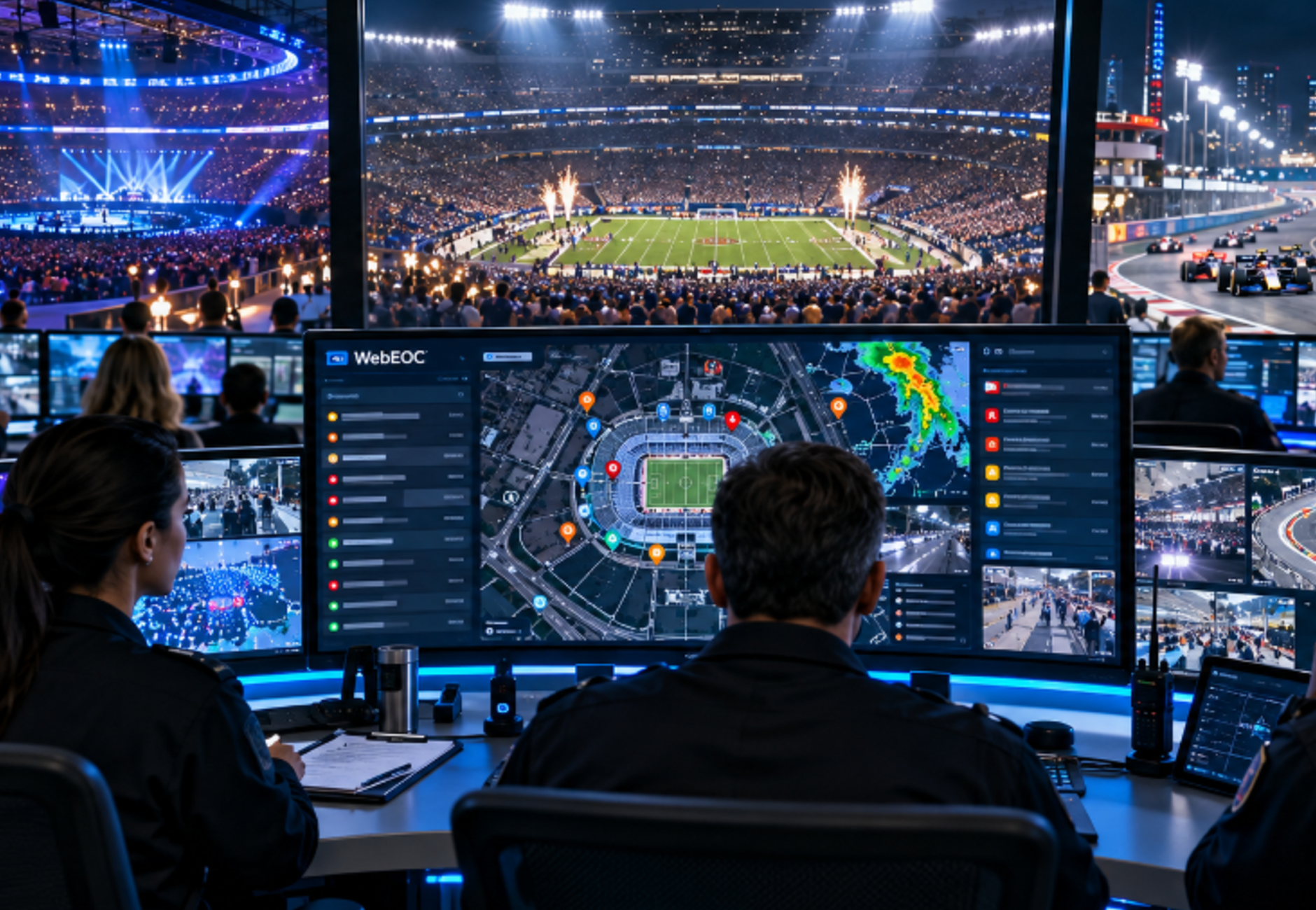
Juvare has partnered with Factal to bring AI-powered detection and editor-verified intelligence directly into WebEOC Nexus, addressing each of the components outlined above as part of a single integrated workflow rather than a separate tool to manage.
Factal continuously scans a broad range of global sources, including severe weather, natural disasters, wildfires, public safety incidents, infrastructure disruptions, and geopolitical developments, to surface emerging incidents in real time. Every alert is then reviewed and confirmed by Factal’s team of experienced journalists before it reaches a customer, filtering out rumor and unconfirmed reports at the source. Customizable alert criteria match those verified alerts to an organization’s specific locations and assets, so teams receive fewer, higher-confidence notifications instead of a high-volume, low-trust feed.
That verified intelligence then flows directly into WebEOC, automatically creating or updating incidents so response teams get situational awareness without monitoring a separate system or manually transferring information. Factal members report accelerating incident response by an average of 28 minutes per event, with efficiency gains equivalent to nearly three additional full-time staff.
The key to these efficiencies is reducing the time teams spend sorting signal from noise. Want to see?
Watch our webinar to see how Juvare + Factal are operationalizing real-time threat intelligence.
Frequently Asked Questions
What is threat intelligence?
Threat intelligence is the practice of monitoring internal and external signals — severe weather, infrastructure disruptions, public safety incidents, geopolitical developments – and evaluating which ones pose a credible, actionable risk to your people, assets, or operations.
How does threat intelligence contribute to operational resilience?
Threat intelligence extends resilience upstream, into the pre-incident phase, by identifying credible risks and assessing potential impact to people and assets before a disruption escalates into a full-scale event.
How does threat intelligence fit into an existing emergency management program?
Threat intelligence works with an emergency management program by feeding it the information that needs response. Verified alerts tied to your specific locations and assets can flow directly into the systems you already use for response coordination.
What is alert fatigue in threat intelligence?
Alert fatigue happens when teams receive so many unverified or low-relevance alerts that they start disengaging from the system altogether raising the risk that a real threat gets missed.
How is threat intelligence different from situational awareness?
Situational awareness is knowing something happened. Threat intelligence is knowing whether it’s real, whether it’s relevant to you, and what to do about it.
Can AI prevent alert fatigue?
Not reliably. AI is fast at detection, but without human verification it tends to generate false positives, which drives alert fatigue rather than preventing it.
What should a threat intelligence program include to avoid alert fatigue?
Four things: broad detection, verification before delivery, prioritization tied to specific assets, and integration into existing response workflows.
Ready to experience verified threat intelligence in your existing response workflow? Request a demo.