How a common operating picture connects the 3Ps of emergency management—people, processes, and products—when it matters most.
Emergency management depends on coordinated action. During a major incident, emergency managers, public safety agencies, government leaders, field teams, utilities, healthcare organizations, and community stakeholders all need to make decisions from the same understanding of what is happening. Yet too often, the information they need is spread across disconnected tools: spreadsheets for resource tracking, email for updates, radio and text messages for field communications, mapping systems for location data, and separate applications for incident documentation, tasking, and status reporting.
Modern emergency management software must connect people, processes, and information in one operational environment. When those elements remain disconnected, teams lose valuable time reconciling data before they can act.
The hidden cost of disparate systems
The challenge is not simply that responders have too many logins or screens. It is that teams must spend valuable time determining which information is current. Is the resource list up to date? Has the evacuation area changed? Which damage report is the latest? Did every relevant leader receive the update? Is the map viewed by the EOC the same one the field team is using?
When data, communications, and workflows live in separate places, the answer is often uncertain. That uncertainty leads to manual workarounds, duplicate data entry, conflicting reports, delayed approvals, and decisions made with an incomplete picture. In a fast-moving event, even small disconnects can compound quickly.
The result is a familiar pattern: the EOC becomes busy collecting and validating information rather than coordinating action. Teams may be working hard, but not always from the same plan.
A common operating picture turns information into coordinated action
A common operating picture (COP) is more than a dashboard or a map. It is a shared, current view of the incident that gives everyone involved a dependable answer to the same essential questions:
- What is happening now?
- Where is it happening?
- Who is affected?
- What actions are underway?
- What resources are available, requested, or deployed?
- What decisions and priorities have been established?
A common operating picture for emergency management gives EOCs and partner agencies real-time situational awareness during fast-moving incidents. When the COP is current and accessible, teams can shift from searching for information to using it. Leaders can see the operational impact of a decision. Field teams can report conditions that immediately inform the broader response. Partners can understand their role and act with confidence.
This does not mean every organization must abandon every specialized system it uses. Weather intelligence, GIS, public alerts, asset tracking, threat intelligence, and field-data tools all provide valuable capabilities. The goal is to connect those inputs into a coordinated operational environment—one that makes relevant information visible, actionable, and accountable.
The 3Ps: people, processes, and products must work together
Strong emergency management rests on three interconnected elements: people, processes, and products. A common operating picture is where all three come together.
People: give every role the context to act
The people involved in an incident do not all need the same level of detail, but they do need aligned information. Emergency managers need a complete operating picture. Elected officials and agency leaders need clear status, risks, and decisions. Field personnel need timely assignments and a way to report conditions. External partners and stakeholders need accurate updates appropriate to their role.
Without a shared operational environment, communication becomes fragmented. One team may receive an update by email, another in a meeting, and another through a phone call or text. Critical details can be delayed, repeated inconsistently, or lost in the volume of messages.
A unified COP creates a common language for the response. It gives every participant a clear view of the incident, their responsibilities, and the latest approved information—reducing confusion while strengthening accountability.
Processes: make coordination repeatable under pressure
Emergency plans, incident action plans, resource-request procedures, and escalation paths make it possible to act decisively under pressure. But even well-designed processes break down when the tools that support them are disconnected.
When information must be copied manually from one system to another, process becomes dependent on individual effort and institutional memory. This makes response slower, introduces errors, and makes it harder to preserve an auditable record of what happened and why.
A common operating picture helps operationalize established processes. It can connect incident reporting, tasking, approvals, resource coordination, status boards, mapping, and situation reporting into a single workflow. That consistency helps teams execute their plans in real time and gives them a stronger foundation for after-action review and continuous improvement.
Products: integrate capabilities instead of adding silos
Technology should make emergency management simpler, not create more systems for teams to manage during an event. The most effective product strategy is not a collection of isolated point solutions; it is an operational platform that brings the right capabilities together.
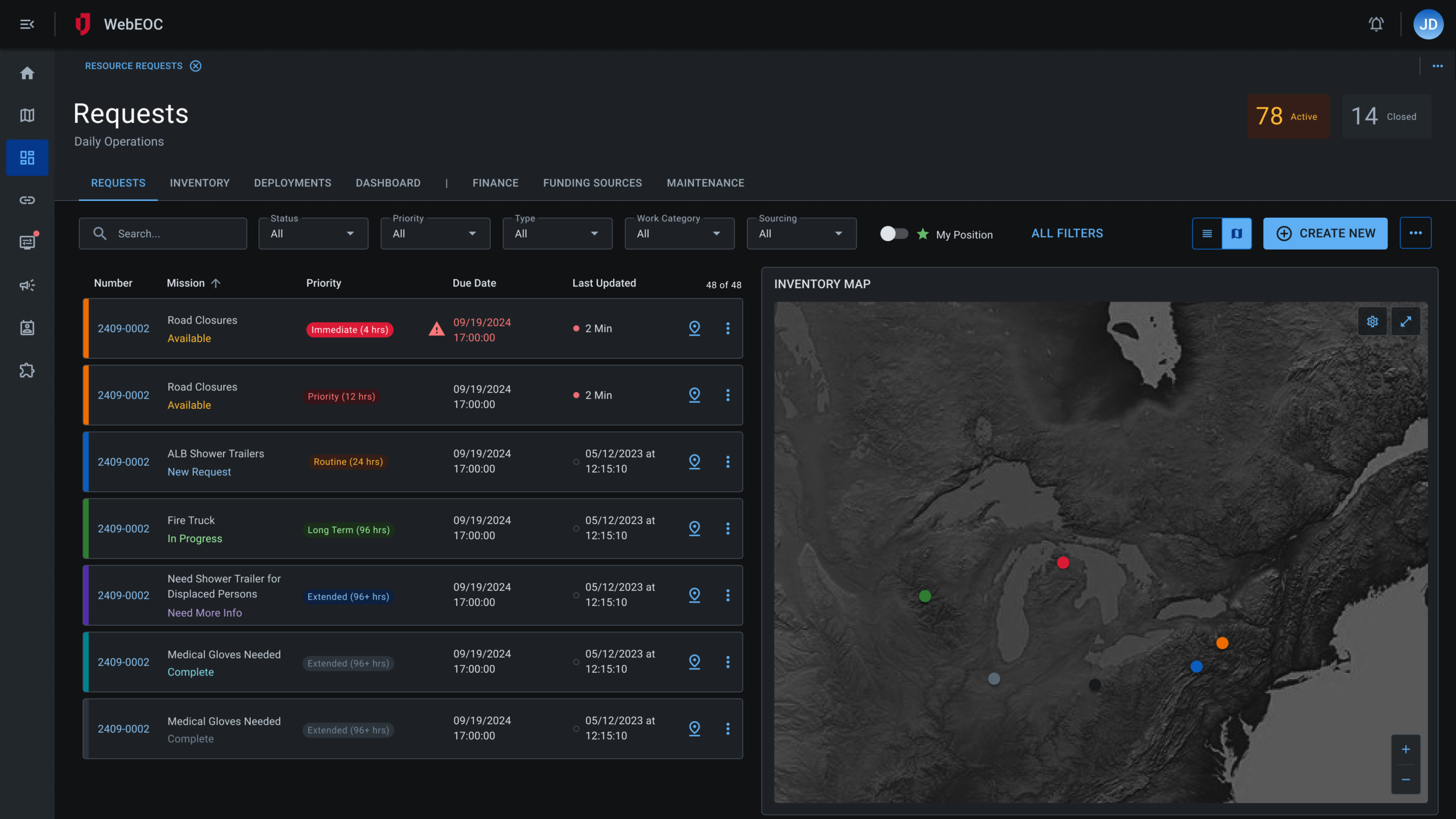
WebEOC is an integrated incident management software platform that supports emergency response coordination, resource management, and unified communications. With connected products, specialized data and tools can contribute to the shared picture without creating another disconnected destination for users.
WebEOC: the single source of truth for the event
WebEOC provides a central environment for managing incidents, coordinating resources, tracking actions, sharing situational awareness, and documenting decisions from preparedness through response and recovery.
As a single source of truth for emergency response, WebEOC helps teams reduce information silos and coordinate action across the incident lifecycle. During an event, validated incident information, operational priorities, assignments, resource status, and key updates can be maintained and shared in one common place to work.
WebEOC turns the COP into a working environment—not simply a view of the incident. Teams can use it to:
- Capture and validate incident reports from across the organization.
- Track requests, assignments, resources, and mission status.
- Bring mapping, weather, threat, asset, and partner intelligence into operational context.
- Share timely, role-appropriate information with emergency management teams, executives, government officials, and stakeholders.
- Maintain a reliable record of decisions, actions, and outcomes for reporting and improvement.
Clear communication is an operational capability
Communication is often treated as a separate workstream from incident management. In reality, it is inseparable from it. An update is only valuable if the right people receive it, understand what it means, and know what action to take next.
A strong COP supports clear, unified communications across emergency management teams, leadership, government officials, and external stakeholders. It provides a trusted foundation for situation reports, executive briefings, partner updates, and public-information coordination. Because the source is shared, teams spend less time debating whose information is correct and more time communicating the decisions that matter.
For leaders, that means visibility into operational status without relying on a patchwork of status calls. For responders, it means fewer conflicting instructions. For government officials and stakeholders, it means more consistent updates and greater confidence that actions are being coordinated.
From information overload to operational resilience
No platform can eliminate the complexity of a major incident. But it can eliminate unnecessary complexity created by disconnected systems and fragmented communication.
For organizations seeking stronger operational resilience, integrated emergency management technology helps turn data into coordinated decisions. The organizations best prepared to manage disruption are not necessarily those with the most tools. They are the ones that align their people, processes, and products around a common operating picture—and give their teams a single, trusted place to coordinate.
With WebEOC as the operational system of record, information becomes more than a collection of updates. It becomes shared understanding, coordinated action, and a stronger response when it matters most.