
Juvare provides organizations with a return-on-investment (ROI) that helps leaders ensure operational efficiency, contain costs, and give time back to emergency management and continuity teams so that they can more readily serve their communities.
- Save on labor costs
- Better allocate essential resources
- Recover federal funds faster
- Expedite damage reporting
- Minimize costly downtime
Here are just a few examples of how real Juvare clients have gotten the most out of their Juvare solutions…
Save on labor costs
A mid-sized coastal county in the southeast recently evaluated its labor usage during a tropical storm activation. With more than 112 personnel involved in response efforts, the county discovered that over 900 total hours were spent on redundant updates, manual logging, and reconciling inconsistent information across spreadsheets, whiteboards, email threads, and text messages.
The county calculated 900+ wasted hours at a $75/hour burdened rate, meaning a $67,500 labor cost during the activation.
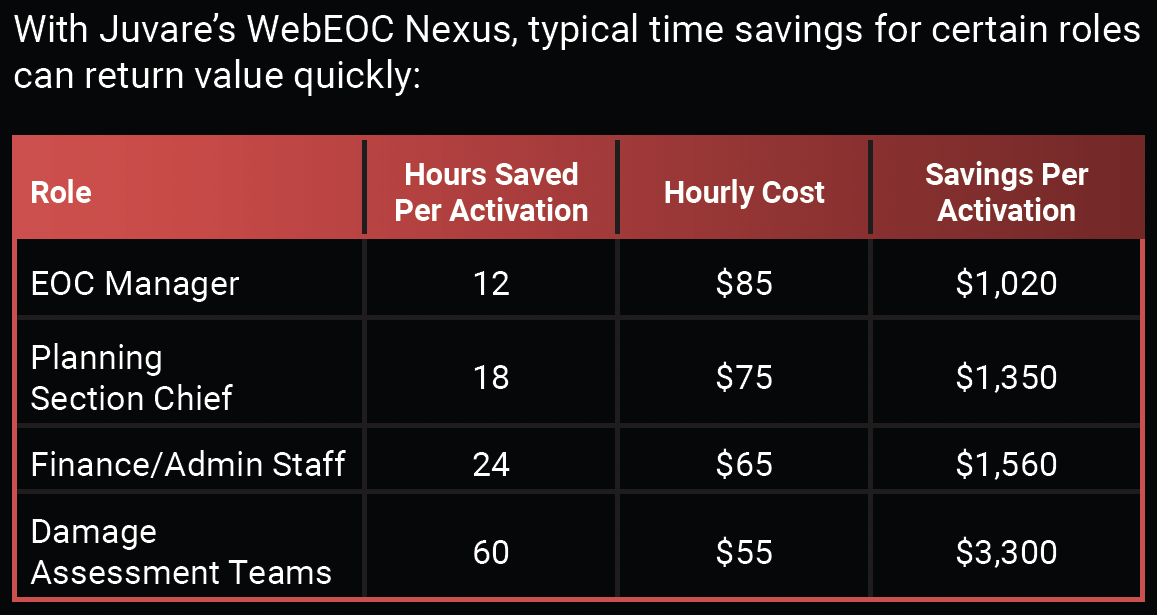
The Juvare Difference: Estimated labor savings per activation with WebEOC implemented = $7,230.
Better allocate essential resources
A coalition in the midwest discovered it took between 2 and 3 hours to establish real-time bed availability across member hospitals due to reliance on phone calls and static spreadsheets. Diversion information was often outdated by the time it reached EMS crews, resulting in misrouted patients and unnecessary Emergency Department (ED) crowding.
This inefficiency resulted in longer transport times, increased risk to patients, and significant avoidable costs for hospitals forced to absorb non-critical visits due to miscommunication.
The Juvare Difference: With one misrouted ambulance costing a hospital system $1,200–$3,600, Juvare’s HealthSuite products help healthcare facilities mitigate these costs.
Recover federal funds faster
A western state emergency management division estimated that it forfeited nearly $1.8 million in recoverable FEMA funds during a wildfire season because required documentation was incomplete or inconsistent. Manual paper logs and scattered spreadsheets made it impossible to maintain a clean audit trail.
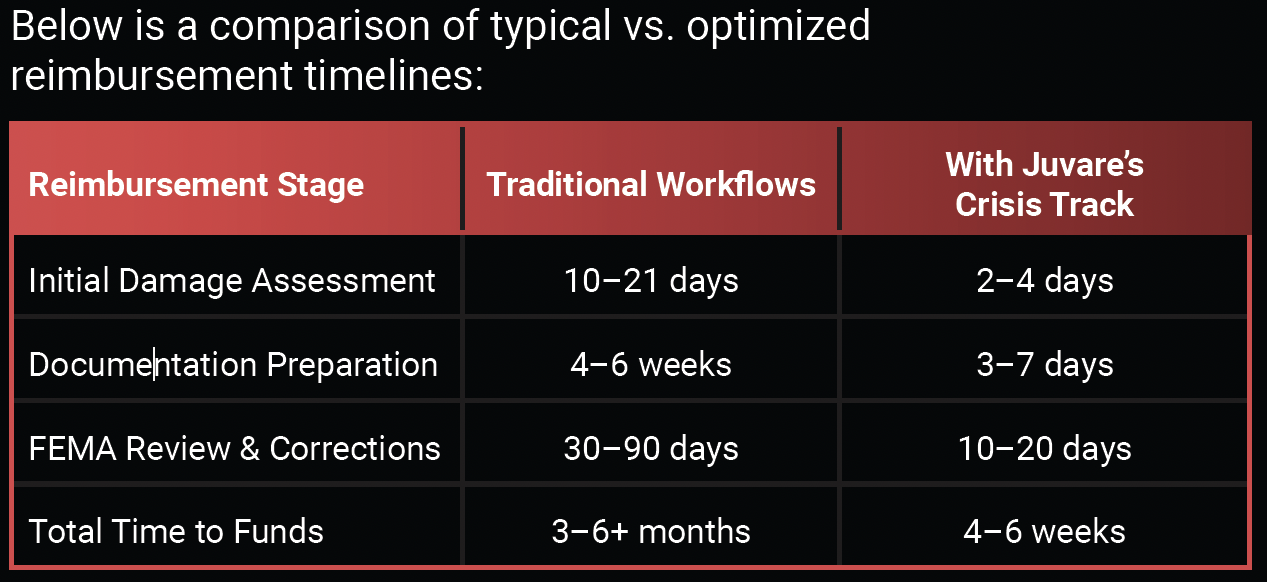
The Juvare Difference: Communities recover funds 2–4 months faster on average when using Crisis Track.
Expedite damage reporting
A midwestern county experienced an EF-3 tornado that damaged more than 400 structures and disrupted power to 38,000 residents. Before implementing WebEOC and Crisis Track, the county relied on text threads and paper maps. During the outbreak, responders used WebEOC to push live road closure data, shelter status, and resource needs. Crisis Track teams assessed more than 300 homes within 48 hours.
The Juvare Difference: WebEOC and Crisis Track can help agencies complete required FEMA documentation weeks faster than with manual/traditional approaches.
Minimize costly downtime
A multinational financial corporation used WebEOC after detecting a ransomware intrusion. As systems were isolated, WebEOC served as the central dashboard for firewall alerts, network status, and business impacts while coordinated IT recovery tasks and executive communication.
The Juvare Difference: The company restored services 4 hours sooner, preventing $3.1 million in potential losses.