
In recent months, major cloud service disruptions affected software across industries, including core financial services tools. For firms reliant on continuous access to infrastructure to process trades, deliver services, and satisfy regulatory requirements, the events caused incident teams across the globe to activate into crisis mode.
These incidents are becoming more frequent and serve as clear reminders that even the most robust systems can be impacted. The real differentiator for organizations is how prepared they are to respond, recover, and lead through disruption.
This blog explores how the financial sector can strengthen its business continuity, incident response, and resilience posture, and why platforms like WebEOC Nexus are becoming essential in that effort.
Impact of Cloud Outages on Financial Institutions: Operational and Regulatory Risks
The impact of the cloud provider’s service outages revealed deep dependencies:
- Applications critical to finance, including trading platforms, customer portals, and compliance tools, went offline.
- Internal teams struggled to communicate and coordinate as support systems went down alongside primary infrastructure.
- Playbooks and plans that relied on the same cloud environment as the failed systems left some teams unable to activate their own crisis responses.
For financial institutions, the consequences of such downtime are amplified:
- Client transactions stall
- Securities processing can halt
- Risk positions go unmonitored
- Regulators take notice
One hundred percent of respondents to a 2025 global executive survey said their companies lost revenue due to IT outages in the previous year. The same study found that an estimated 90% of mid-sized and large enterprises lose more than $300,000 per hour of downtime.
Outages like this challenge IT infrastructure, organizational leadership, and preparedness.
Why Financial Institutions Are Uniquely Exposed
The financial sector operates on a foundation of trust, time sensitivity, and regulation. This makes service resilience a core business requirement.
Top 5 Risks of Cloud Outages for Financial Services
- Operational Risk: Critical systems may be unavailable, affecting trading, clearing, payments, and more.
- Regulatory Compliance: Regulators require proof of operational resilience and may scrutinize firms that suffer extended outages.
- Reputational Risk: Clients expect 24/7 access to services. Failure to deliver erodes confidence quickly.
- Third-Party Dependency: Even firms with strong internal systems are exposed when cloud vendors or SaaS providers experience downtime.
- Incident Response Readiness: Operational resilience is about people, processes, and coordination. Access to core services is therefore a top necessity.
Enhancing Financial Incident Response with WebEOC Nexus
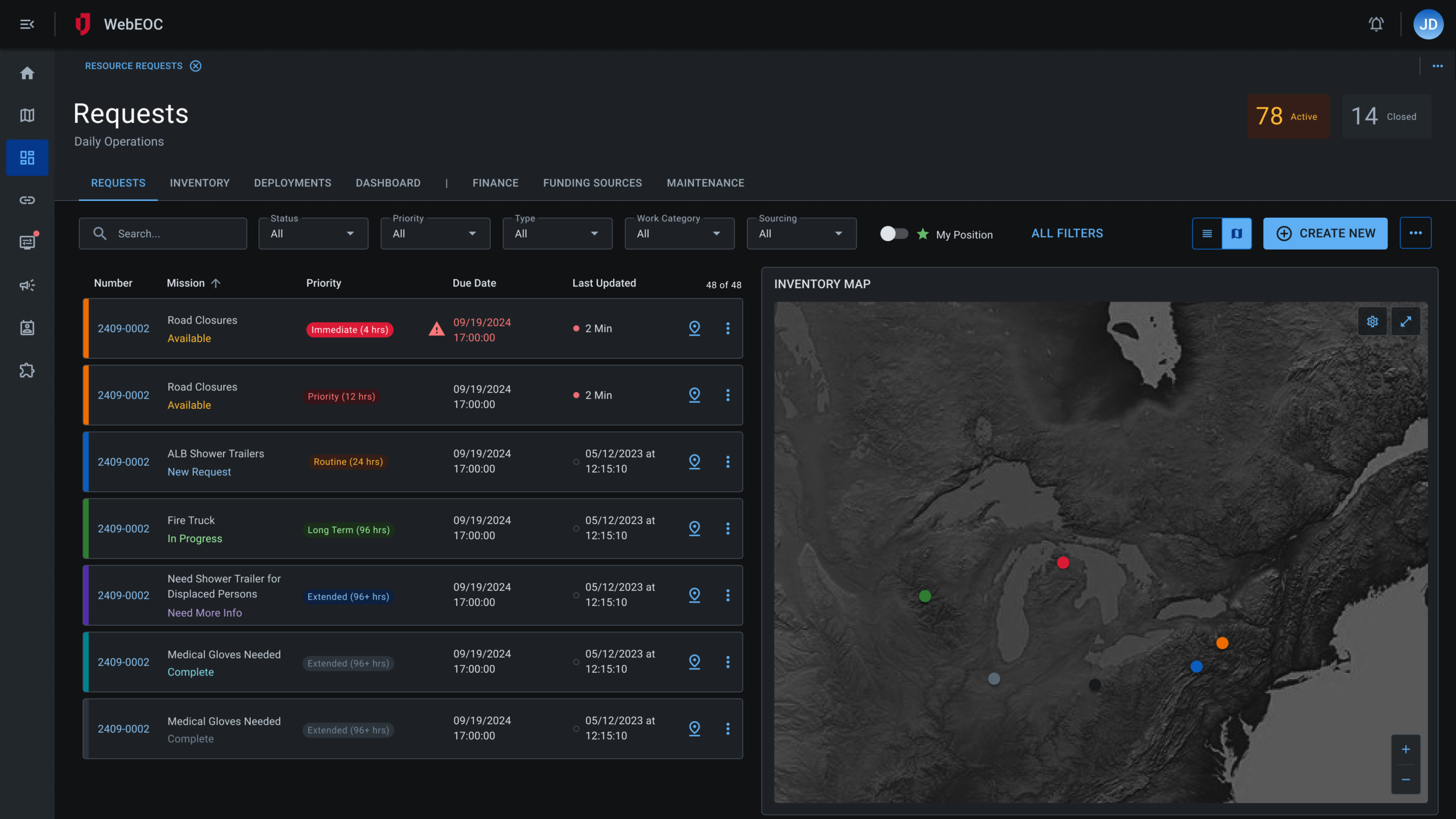
WebEOC Nexus is a platform built to help organizations prepare for, manage, and recover from disruptions. For financial services firms, it becomes a central hub for decision-making during outages.
Key Capabilities
Real-Time Situational Awareness: Keep executives, compliance officers, and operational teams aligned in real-time during fast-moving events.
Centralized Incident Management: Activate tailored workflows for cyber incidents, vendor outages, or infrastructure failures in one place.
Task Tracking and Role Assignment: Reduce confusion and speed up recovery with clearly defined responsibilities and response steps.
Stakeholder Communication: Ensure that internal teams, clients, vendors, and regulators receive timely updates with integrated notification tools.
Regulatory Reporting and Audit Trails: Automatically capture response actions for after-action reviews and compliance documentation.
These features enable financial institutions to move from fragmented response to coordinated action, in minutes, not hours. [Click here to request a demo.]
How WebEOC Nexus Maintains Availability During Cloud Outages
A critical question during any outage is: Will our incident response tools stay up when our infrastructure goes down?
WebEOC Nexus is architected with resilience in mind. Unlike platforms that depend entirely on a single provider or region, WebEOC Nexus is designed to stay online even when critical cloud services are disrupted.
Cloud-Hosted, Highly Redundant Architecture
WebEOC Nexus’ cloud hosting is configured for:
- Load balancing between availability zones
- Multi-region failover
- Load-balanced architecture
- Automated backup and recovery
This high-availability design ensures WebEOC Nexus remains accessible even if a major cloud region experiences failure. It enables institutions to keep their response workflows, communications, and task management fully functional when core systems are offline.
Designed for Continuity, Not Just Convenience
Originally built for multi-industry business continuity and disaster response, WebEOC Nexus is engineered for mission-critical operations. That same philosophy applies perfectly to WebEOC Nexus’ tailored finance instances, where the cost of delay is high and maintaining compliance is a top priority.
General SaaS Tools
- Typically designed for day-to-day business productivity rather than crisis conditions
- Rely on static workflows that break down during disruptions
- Limit real-time coordination
- Operational and communication layers often fail simultaneously during outages
- Offer minimal auditability when systems or processes fail
WebEOC Nexus
- Purpose-built for incident management and operational continuity
- Incident-ready workflows that remain functional under pressure
- Integrated, real-time communication and notifications via Juvare Exchange
- Continuous visibility into vendor status and operational impact
- Built-in audit logs to support compliance, review, and post-incident analysis
During the 2025 outages, many organizations lost both their operational and coordination layers. WebEOC Nexus customers, by contrast, retained full situational control. This provides a key advantage in managing both the business and the incident.
Next Steps: Building Resilience Before the Next Outage
Here are five actions financial services firms should take today:
- Map Critical Dependencies: Identify what systems, vendors, and infrastructure support key services such as trading, payments, and reporting.
- Build Targeted Playbooks: Create response plans for scenarios like cloud region outages, vendor failures, or system-wide latency events.
- Run Simulations: Test your response using platforms like WebEOC Nexus to coordinate cross-functional teams.
- Ensure Platform Redundancy: Confirm that your incident management tools, and your operational platforms, will be accessible during outages.
- Capture Lessons and Adapt: Use after-action reviews and built-in analytics to evolve your response plans continuously
Conclusion: Resilience Is a Leadership Decision
What is operational resilience in finance? It’s the ability of firms to prevent, adapt to, respond to, recover from, and learn from operational disruptions. Downtime leads to loss of trust in financial services, but outages will happen. The question is whether your organization is positioned to lead through them or to scramble behind the curve.
To respond to disruption with speed and confidence, firms need scalable infrastructure that delivers the right insights at the right time. WebEOC Nexus keeps your organization connected, coordinated, and in control when it matters most.
Don’t wait for the next outage to test your readiness. Schedule a demo today to secure your operational resilience.