
For public-sector organizations, building and maintaining constituent trust is crucial to fulfilling your mission effectively. However, sustaining that trust has become increasingly difficult. According to a recent report from the Pew Research Center, trust in government is lower than it’s been in decades. To reverse this trend, agencies must adopt modernized processes to resolve concerns quickly and effectively.
This is where investigative case management comes in. By establishing a solid framework for handling sensitive information like public complaints or internal misconduct, agencies demonstrate that they take citizens’ concerns seriously.
In this article, we’ll explore the foundational basics of investigative case management and help you find the tools you need to improve collaboration, strengthen the accuracy of insights, and ensure compliance.
Investigative Case Management FAQ
What is investigative case management?
Investigative case management is the process of handling criminal, civil, regulatory, administrative, and oversight complaints, violations, and reports from intake to the final resolution.
Organizations in the public sector use this structured framework to maintain reliable records, streamline the investigation process, and identify meaningful patterns and trends across cases and reports.
Investigative case management ensures every step of the investigative lifecycle is routed to the appropriate team and consistently documented within a centralized and auditable system. Ultimately, its goal is to support thorough, consistent, and defensible investigations that can withstand legal, regulatory, and public scrutiny.
Who needs investigative case management?
Virtually any public sector or enterprise organization responsible for conducting investigations, enforcing regulations, ensuring compliance, conducting criminal or civilian oversight, or overseeing the use of public or sensitive resources requires robust investigative case management. This includes law enforcement agencies, oversight and inspector general, regulatory bodies, intelligence-adjacent agencies, corporate security divisions, and a wide array of government agencies.
The demands of case management vary depending on the sector and jurisdiction. State and local government agencies, for example, often handle localized incidents: e.g., public complaints, municipal zoning and code violations, permit issues, or service-related incidents. For these organizations, a case management system must be an agile, accessible system that supports quick intake with configurable workflows and stores structured documentation.
Federal and civilian agencies, on the other hand, face multi-jurisdictional investigations involving complex financial fraud, ethics and misconduct violations, or organized criminal activities that often span across multiple agencies and occur with higher frequency. These federal entities require hyper-secure, scalable, interoperable systems that can handle sensitive cases with the utmost discretion and seamless inter-agency collaboration.
What are the benefits of investigative case management?
The benefits of effective investigative case management include:
- Increasing public trust: A rigorous, auditable, and unbiased investigation process demonstrates to citizens that your organization holds itself to the highest possible standards and cares about their concerns.
- Ensuring compliance: Track every action and keep documentation aligned with legal standards and internal agency policies by using consistent processes and compliance-focused tech.
- Driving operational efficiency: Proper investigative case management streamlines and centralizes the entire investigation process from intake and triage to adjudication and closure. As a result, caseworkers can work more efficiently.
- Optimizing resource allocation: With real-time insights into caseloads, bottlenecks, and emerging trends, you can proactively mitigate risk and allocate resources effectively.
What is the role of technology in investigative case management?
Modern investigative case management is a tech-forward process that uses investigation management software to support efficiency and accountability. Your technology can:
- Enhance case integrity
- Automate task routing and cross-jurisdiction collaboration
- Track the chain of custody for both digital and physical evidence
- Maintain immutable audit logs for every action
- Leverage artificial intelligence to assist with oversight, instantly summarizing case progress and delivering role-based insights to track risk and workload
Centralized investigative management technology eliminates the reliance on fragmented, disjointed spreadsheets or paper-based workflows, consolidating investigative data into a single source of truth, streamlining and securing the entire investigation process.
Common Types of Cases
Investigation case management software supports a wide variety of complaints, referrals and investigative reports from the public related to an organization’s objective and operations. Here, we’ll cover some of the most common types of cases along with the key considerations of managing these cases.
Internal Professional Standards
The integrity of a government agency depends on how its personnel conduct themselves. Allegations of official misconduct, abuse of authority, or administrative negligence must be handled with impartiality and consistency. An investigative case management system creates a clear audit trail while protecting your sensitive data throughout the process.
Whistleblower Claims
When an insider speaks out about fraud, safety risks, or illegal activities within an organization, investigations must ensure absolute anonymity and protection against retaliation. A secure case management system enables agencies to investigate allegations while protecting the identity of reporting parties.
Critical Infrastructure Vulnerabilities
Civilian agencies and regulatory bodies investigate physical and cyber threats to critical infrastructure, such as power grids, municipal water supplies, and public transit systems. When a vulnerability is identified or a breach occurs, the investigation requires collaboration between structural engineers, cybersecurity experts, and federal regulators. Case management software enables this collaboration and tracks mitigation efforts to ensure a vulnerability doesn’t escalate into a full-fledged crisis.
Public Health and Safety Compliance
State and local health departments must monitor and investigate potential threats to public well-being, including epidemiological outbreaks, localized public health crises, and chronic health code violations at commercial facilities. A robust case management platform allows you to synthesize massive amounts of data, identify geographic patterns, coordinate rapid interventions, and track compliance over time.
Improper Authorization Documents
State and local governments are responsible for issuing thousands of licenses and permits, from professional medical licenses to commercial construction permits. Investigations often arise when there are allegations of businesses operating without proper authorization, individuals falsifying credentials, or entities violating the terms of their specific permits. Effective case management allows agencies to cross-reference application data, track site inspections, and enforce regulatory compliance swiftly.
Misuse of Public Funds
Government agencies’ budgets are funded by taxpayer dollars. Responsible stewardship of these funds is vital for maintaining trust and compliance. Investigations into the misuse of public funds, embezzlement, or grant fraud are incredibly complex, often requiring the analysis of dense financial records and vendor contracts. A centralized case management system helps you map financial relationships, track cash flow, and recover misallocated assets.
Civil Rights and Equal Opportunity Violations
Agencies operating at both the state and federal levels are responsible for investigating civil rights complaints, including allegations of housing discrimination, workplace inequalities, and ADA non-compliance. Because of the sensitive nature of these cases, investigations must be handled with consistency, speed, and strict adherence to privacy and legal standards.
Phases in the Investigative Case Management Process
No matter what type of case is being managed, a consistent process is required to ensure investigative case management is efficient and transparent. The phases in the process are:
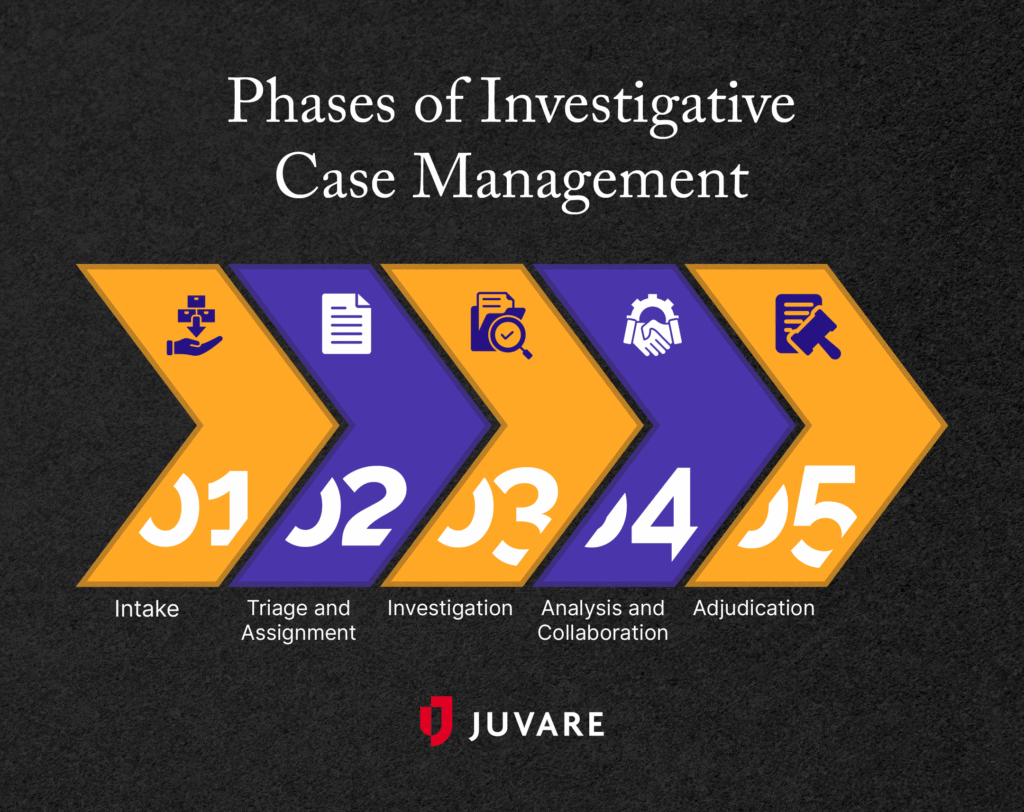
1. Intake
The investigative lifecycle begins the moment a complaint is filed or an anomaly is flagged. Your agency should have multiple intake channels, such as anonymous hotlines, web portals, or internal referrals, to ensure reports can be submitted easily by both public and internal staff. To strengthen public awareness, agencies should also conduct proactive outreach to clearly communicate how and where complaints can be filed.2. Triage and Assignment
Once you receive a report, the triage process begins. This involves a rapid assessment of the complaint’s credibility, urgency, and jurisdiction. The ultimate goal is to determine whether the report warrants a full investigation and to assign the case a priority level. Following triage, the case must be assigned to the appropriate investigator or caseworker.3. Investigation
During this phase, investigators/caseworkers will conduct interviews, request and review documents, analyze financial and administrative records, and perform site inspections to collect evidence. Documentation is a core part of this phase, as every action and evidence must be recorded in a manner that is auditable, defensible, and consistent with governing standards. Automatic timestamps and version control help you keep your progress organized and support traceability of activities to preserve the integrity of the case and investigative findings.4. Analysis and Collaboration
Once sufficient evidence has been collected, findings are analyzed, identifying patterns, corroborating testimonies, and reconciling inconsistencies. This phase also requires collaboration between HR, legal, and oversight teams so that they can review findings and share insights.5. Adjudication
After the investigation is complete, the proper authorities will decide how the case should be resolved. Depending on the agency and the case, this could mean issuing a fine, revoking a license, referring the case to a judicial body, or simply closing an unfounded complaint. At this point, you’ll also need to ensure you have standardized, compliant reports that clearly outline the evidence and each action taken during the investigation.
The Risk of Fragmented Investigative Case Management
Many agencies still rely on disjointed tools or paper processes to manage investigations without realizing the risk that fragmented investigative case management poses to their organizations. The following risks endanger both the integrity of individual cases and an agency’s overall reputation.
Data Silos
Traditional investigative case management has evidence scattered across separate email threads, hard drives, and disparate software tools. As a result, investigators waste time hunting for basic intel instead of getting to the bottom of a case. A centralized system, on the other hand, prevents redundancy and missed connections.
Compliance Risks
Manual data handling increases the risk of chain-of-custody errors and data privacy violations, which ultimately increases the likelihood that your evidence will be considered inadmissible because no one can definitively say who had access to what data when. Furthermore, moving sensitive information across unsecured, disjointed channels drastically increases the risk of data breaches.
Delayed Response
In high-stakes cases, time is of the essence. If your organization is working in disjointed systems and unable to synthesize information quickly, there is an increased risk that disruptions will drag on or even escalate. Fragmented investigative case management slows down triage and analysis. In contrast, a centralized system will enable your team to quickly deploy resources and issue public statements to neutralize a risk.
How to Choose Investigative Case Management Software
The right investigative case management software will help your agency streamline the entire investigative process, from initial intake to adjudication. A centralized system will save you time, secure your compliance, and help you make more informed decisions. However, choosing the best investigative case management software for your needs can feel overwhelming.
To help, we’ll outline the core features you should look for and describe the selection process to help you prepare.
Core Features
While your agency will likely have unique desires for your software, it’s helpful to understand the core features that real investigative case management software users have found most helpful. For example, Juvare’s Investigative Case Management System (ICMS) offers the following features:
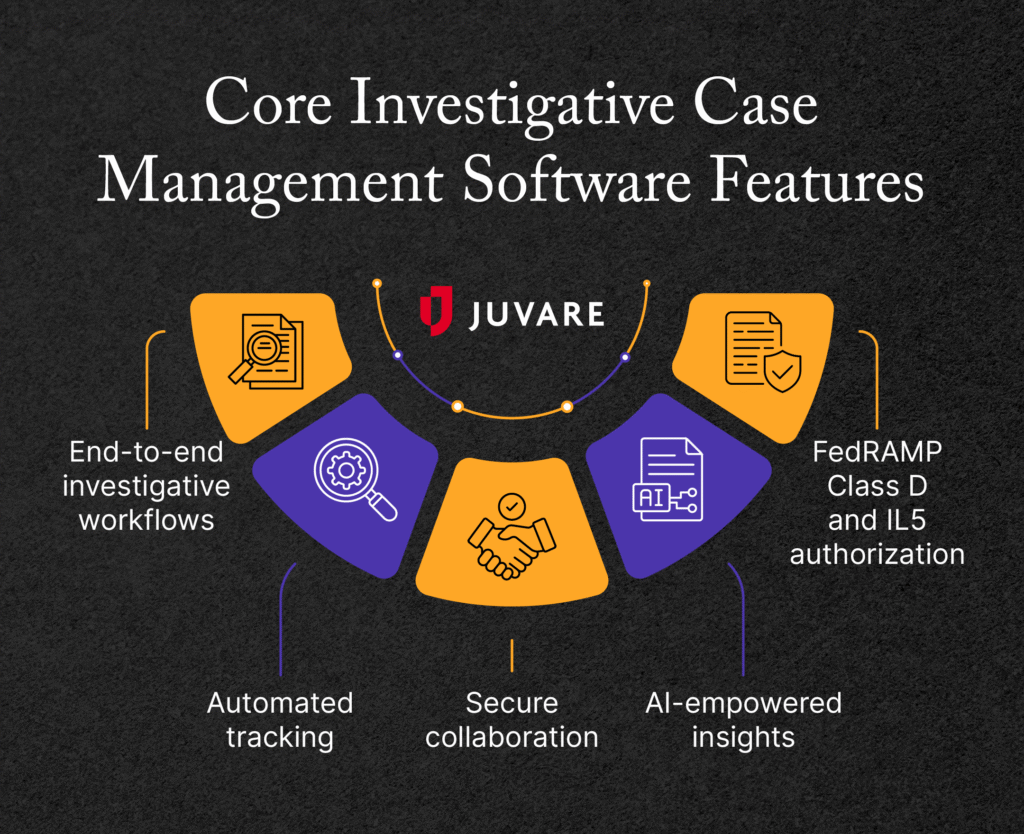
- End-to-end investigative workflows: Manage every phase of the investigative process from the same platform. Our platform includes features like a secure complaint intake system, triage tools, digital evidence management, and audit trail logging to improve oversight, accountability, and efficiency.
- Automated tracking: ICMS tracks every action and document in your investigation. With version control, timeline auditability, and built-in full document history, you’ll never lose track of a piece of evidence or risk your compliance.
- Secure collaboration: HR, legal, and oversight teams can all communicate and share data through ICMS without worrying about data breaches or missed messages.
- AI-empowered insights: Instantly summarize case progress and track emerging trends with Juvare’s AI assistant.
- FedRAMP Class D and IL5 authorization: Our solution meets the most stringent security requirements for federal agencies.
ICMS integrates directly with our United Command Platform for government agencies, making it easy to implement and use.
The Selection Process
With a foundational understanding of the uses of investigative case management software, you’re ready to enter the selection process. Click through each of the three stages of the process to gain insights that will guide you to the right solution for your needs.
Once you’ve chosen your solution, develop a solid implementation plan. Do you need phased rollouts? Who should receive comprehensive user training? How will you migrate sensitive legacy case data? Establish clear Standard Operating Procedures (SOPs) for using the new system to create a smooth transition.
Additional Resources
Modernizing the way your agency handles civilian complaints and internal inquiries is vital for establishing and maintaining your constituents’ trust. By understanding the demands of the investigative case management process and investing in the right technology, you can eliminate data silos, streamline complex administrative workflows, and ensure your compliance.
To learn more about protecting your agency and demonstrating your trustworthiness, check out these resources:
- Continuity of Operations (COOP) Planning: The Ultimate Guide: Ensure your government can keep essential operations running during and after a crisis. Learn how to create an effective COOP plan.
- How to Build Cyber Resilience to Ensure Continuity: Data breaches can endanger your sensitive data, spread misinformation, and undermine constituents’ trust in your organization. Explore cyber resilience strategies here.
- How Situational Awareness Fuels Emergency Preparedness: Situational awareness helps organizations prepare for, respond to, and recover from crisis situations. Learn how a critical incident management platform helps.