
A hospital’s emergency plan usually lives in three places at once: a binder in the EOC, a PDF on the intranet, and whatever team members recall from last year’s drill. This works… until a mass casualty event, an infectious disease surge, or a multi-day power outage hits and the gap between having a plan and running one becomes visible quickly.
What Is Healthcare Emergency Management?
Healthcare emergency management is the ongoing discipline of preparing for, responding to, and recovering from events that threaten a hospital’s ability to deliver care. This can range from events like a single-facility power outage to a regional mass casualty incident. Healthcare emergency managemetn spans daily operational readiness, not just declared disasters, and it applies across hospitals, EMS, long-term care, and public health agencies that all have to work from the same information when something goes wrong. The stakes of getting this wrong are financial as well as clinical. Hospital downtime costs an average of $7,500 per minute, with large hospitals losing as much as $25,000 per minute.1
Hospital emergency management specifically refers to how an individual facility organizes this work: activating an incident command structure, tracking patients and resources, communicating with staff and partners, and documenting the response for compliance and improvement.
What Are the Four Phases of Emergency Management for Hospitals?
Most hospital emergency management programs are organized around four phases, each with a distinct job:
- Mitigation. Reducing the likelihood or severity of a future event through activities such as hardening infrastructure, maintaining backup power, and identifying hazards via Hazard Vulnerability Analysis (HVA).
- Preparedness. Building the plans, training, and resources needed to respond effectively, from drills and exercises to mutual aid agreements and critical supply stockpiles.
- Response. Executing the plan during an active event. This means activating incident command, triaging patients, allocating resources, and communicating with staff and partners in real time.
- Recovery. Returning to normal operations and documenting what happened with after-action review, corrective action tracking, and restoring systems and staffing to baseline.
These phases aren’t really sequential in practice; mitigation and preparedness happen continuously, while response and recovery activate around specific events. A hospital emergency management program is judged on how well all four phases connect rather than any one phase in isolation.
What Does Hospital Emergency Preparedness Require?
Hospital emergency preparedness is the second phase above and also where most of the day-to-day compliance and planning work lives. It’s the operational infrastructure (including data, communication, and coordination) that lets a facility keep functioning under strain instead of just describing how it should function. In practice, it requires:
- A current Hazard Vulnerability Analysis (HVA) identifying the specific risks a facility faces and how likely and severe each one is.
- A written Emergency Operations Plan (EOP) covering command structure, roles, communication protocols, and response procedures by hazard type.
- Regular training and exercises, including tabletop exercises and full-scale drills, aligned with the Federal Emergency Management Agency’s Homeland Security Exercise and Evaluation Program (HSEEP) standards.
- Mutual aid and coalition agreements with neighboring hospitals, EMS, and public health partners for surge support.
- Resource and supply readiness, including PPE stockpiles, backup power, and pre-identified alternate care sites.
- Regulatory compliance with the CMS Emergency Preparedness Rule and The Joint Commission’s Emergency Management (EM) standards, both of which require documented planning, training, and testing.
Emergency preparedness remains one of the most frequently cited deficiency areas across CMS surveys.2 Preparedness that only exists on paper tends to reveal itself the same way every time: during an actual event, when someone has to go find the plan, interpret it under pressure, and coordinate a response that was never rehearsed with the tools being used that day.
Hospital Emergency Preparedness vs. Healthcare Emergency Management: What’s the Difference?
The two terms are related but not interchangeable:
| Hospital Emergency Preparedness | Healthcare Emergency Management | |
| Scope | One phase: planning, training, and resource readiness before an event | The full lifecycle: mitigation, preparedness, response, and recovery |
| Primary question | Are we ready if something happens? | How do we operate before, during, and after something happens? |
| Typical owner | Emergency preparedness coordinator, safety officer | Incident command team, EOC leadership, cross-agency partners |
| Regulatory anchor | CMS Emergency Preparedness Rule, Joint Commission EM standards | HSEEP, NIMS, HICS, plus the same CMS/Joint Commission standards |
Essentially, preparedness is the work you do before the event. Emergency management is the complete system (preparedness included) that carries a hospital through the event and back to normal operations.
What Should Be on a Hospital Emergency Response Checklist?
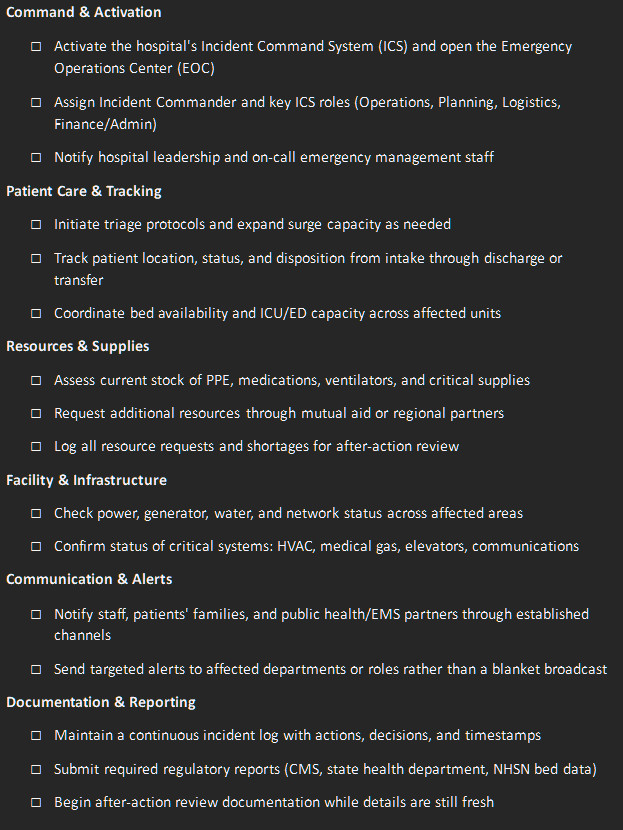
Here are the core actions during the first hours of a hospital emergency response, organized by function:
Why Do Checklists Struggle?
On paper, this works. Plans exist, drills activate, and HSEEP-aligned after-action reports get filed. However, a breakdown often happens in the handoff from plan to execution because:
- Status is manual. Bed counts, generator status, and PPE stock get tracked in spreadsheets or phone calls, so the picture leadership sees during an event is already stale.
- Reporting is disconnected. Facility-level data doesn’t flow automatically to state or federal systems (like the CDC’s NHSN bed capacity initiative), so staff are re-entering the same numbers into multiple portals under pressure.
- Communication isn’t targeted. Mass notifications go out broadly instead of to the right role, the right facility, or the right region, and there’s no reliable way to confirm who got the message.
- After-action findings don’t turn into fixed processes. Improvement plans get written and then sit until the next drill surfaces the same gap again.
Preparedness that holds up under real conditions requires the same categories of work as in the checklist — facility status, resource tracking, communication, patient tracking, incident command, and after-action review — but wired into workflows people are already using. Additionally, plans don’t work if hospitals, EMS, long-term care, and public health are each looking at their own version of the truth. For successful emergency response, there must be airtight data-sharing among key parties.
How Does Software Support Healthcare Emergency Management?
Strip hospital response down to its working parts and it looks like this:
- Facility status — Real-time visibility into bed availability, utilities, generator and power status, and hazard vulnerability, rolled up by department, facility, or region.
- Resource and capacity tracking — ICU occupancy, ventilator counts, PPE stock, and specialty care availability, visible to hospitals, EMS, and public health simultaneously (a task that otherwise costs the average facility two to four staff hours per day, or $30,000–$60,000 a year in manual labor).
- Incident command activation — Pre-built incident templates, pre-identified ICS positions, and role-based tasking so responders know their job the moment an incident opens, without waiting on manual assignment.
- Patient and population tracking — A single record following patients from EMS pickup through triage, transport, and discharge — critical for MCIs, evacuations, and family reunification.
- Multi-channel alerting — Automated and ad-hoc notifications via text, voice, email, and webhook integrations, triggered by workflow changes like a facility status update or an emerging infectious disease trend.
- Volunteer and credential management — Pre-vetted, credential-checked responders who can be deployed to a mission in minutes, not recruited from scratch mid-event.
- After-action review with corrective action tracking — Real-time participant feedback tied to a documented improvement plan and aligned to HSEEP standards, so lessons actually change the next response.
How Does Juvare Support Hospital Emergency Preparedness?
From our suite of purpose-built healthcare software (HealthSuite) to our flagship WebEOC Nexus, Juvare solutions map well to the emergency response and daily operations needs of hospitals.
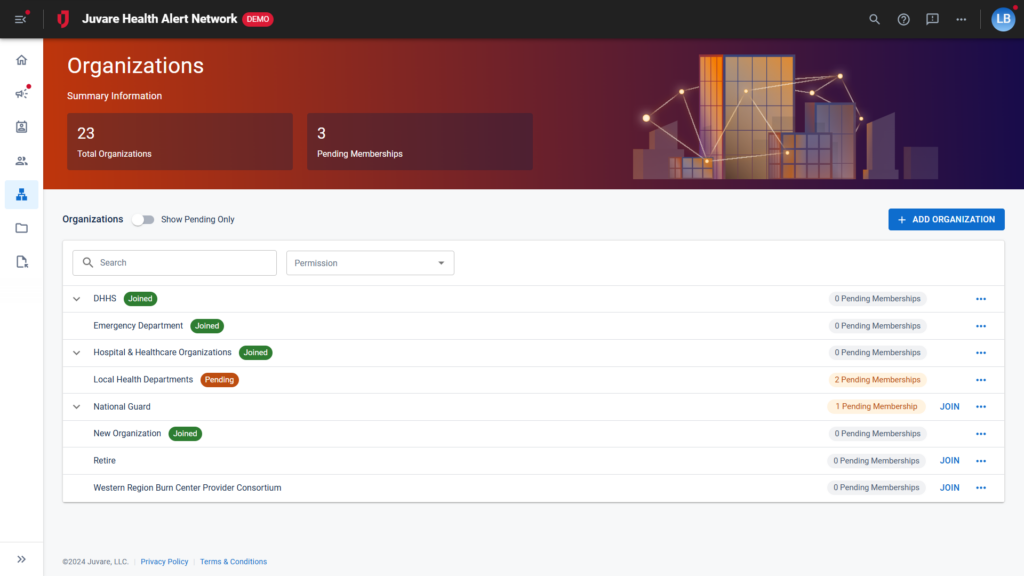
Juvare’s HealthSuite covers these needs with purpose-built healthcare tools including EMResource (with BedSync) for facility status and bed capacity reporting, EMTrack for patient and population tracking, eICS for incident command, and CORES HAN and CORES RMS for alerting and volunteer management.
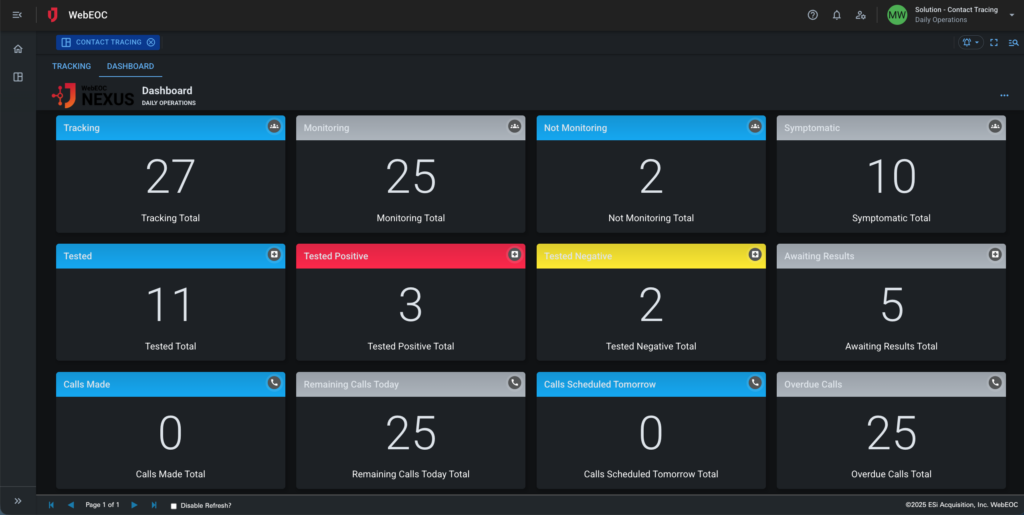
WebEOC Nexus adds a broader operational layer on top for healthcare providers, connecting facilities, agencies, and community partners through shared boards and secure role-based data sharing via Juvare Exchange.
You can read more about how Juvare supports the full lifecycle on our hospital emergency preparedness industry page.
FAQ
What is hospital emergency management? Hospital emergency management is the discipline of preparing for, responding to, and recovering from events that threaten a hospital’s ability to operate — organized around four phases: mitigation, preparedness, response, and recovery.
What’s the difference between hospital emergency preparedness and healthcare emergency management? Preparedness is one phase — the planning, training, and resource readiness completed before an event. Healthcare emergency management is the full lifecycle, including preparedness, plus response and recovery.
What should be on a hospital emergency response checklist? At minimum: command and activation, patient care and tracking, resources and supplies, facility and infrastructure status, communication and alerts, and documentation and reporting.
What regulations govern hospital emergency preparedness? In the U.S., the CMS Emergency Preparedness Rule and The Joint Commission’s Emergency Management standards require documented plans, training, and testing. Many programs also align training and exercises to FEMA’s HSEEP standards.
How often should a hospital test its emergency preparedness plan? CMS requires at least one full-scale or tabletop exercise annually, along with regular plan review; many hospitals run additional drills throughout the year to stay ahead of staff turnover and evolving risks.
Preparedness is proven the moment status has to be reported, patients have to be tracked, and the right people have to be reached securely all at once. If you’re ready for smoother operations, request a demo for a walkthrough tailored to you.
Sources
- Censinet, Inc. (2025). Healthcare Downtime Costs Hospitals $7,500 Per Minute on Average, Study Shows. https://censinet.com/perspectives/healthcare-downtime-costs-hospitals-average-study
- Centers for Medicare & Medicaid Services and ASPR TRACIE. (2026). Emergency Preparedness: Deficiency Analysis & Provider Resources. https://asprtracie.hhs.gov/technical-resources/resource/13429/emncy-preparedness-deficiency-analysis-provider-resources
About Andy

Andy Van Pelt, MBA, is Vice President of Healthcare at Juvare, where he works at the intersection of policy and healthcare coordination through technology. A nationally recognized leader in healthcare and health system coordination, he brings more than 20 years of experience in healthcare policy, government affairs, and executive leadership. He previously led a for-profit data and analytics company, where he oversaw the design and launch of one of the nation’s first real-time, statewide hospital capacity systems during COVID-19. He has also advised national agencies and states on scaling real-time capacity reporting.